Andreas Wocke | RiseOfMind.com
India is a country that stays with you. Since my first visit in 2009, I have been going there two or three times a year – and every trip brings new impressions, new insights and, time and again, new surprises. What began with initial customer visits to BOSCH in Bangalore (now Bengaluru) has developed into something more permanent over the years: A collaboration with my first colleagues (with whom I still work) led to the establishment of an Indian branch, which today employs around 70 people in Bengaluru in the areas of software development, testing and sales – with all the ups and downs that time brings. This series of articles is neither a travelogue nor an academic analysis. These are my personal impressions from practical experience – subjective, certainly incomplete, but honest.
For anyone considering working with India – whether as an entrepreneur, manager or simply as a curious observer – I would like to offer a sober, practical insight. Without clichés, without whitewashing.
The airport – a first impression in two acts
Entry: Welcome to bureaucracy
Anyone landing in India will notice at passport control that things work differently here. For several months now, there has been an online pre-registration system designed to simplify the process somewhat – but the actual procedure has not changed. Every visitor is carefully processed for several minutes: the official looks here, writes there, asks questions, checks and compares – five minutes or more per person is not uncommon. If several planes arrive at the same time, it can take up to two hours to get out of the airport. There are certainly more efficient systems. India has its own unique approach to bureaucracy, and it is deeply rooted – more on that later.
Departure: a special feature you should be aware of
Anyone leaving India for the first time will experience a surprise that I have hardly ever encountered in any other country: you can only enter the departure terminal if you can prove that you are actually flying. Sounds logical – but there's a catch. When you check in online, you don't get a boarding pass on your smartphone. You only get your boarding pass at the terminal, at the check-in counter. What you need to even get into the building is your booking confirmation – ideally printed out, if you don't want to hand your smartphone over to the soldier in full uniform. If you don't have it with you, you'll be left standing in front of closed doors.
Automatic barriers are currently being installed that also accept digital booking receipts. The process is sure to change at some point, but until that happens across the board, it's best to print out your booking confirmation before heading to the airport.

Traffic: chaos as the norm
The next and inevitable impression follows on the way from the airport to the city.
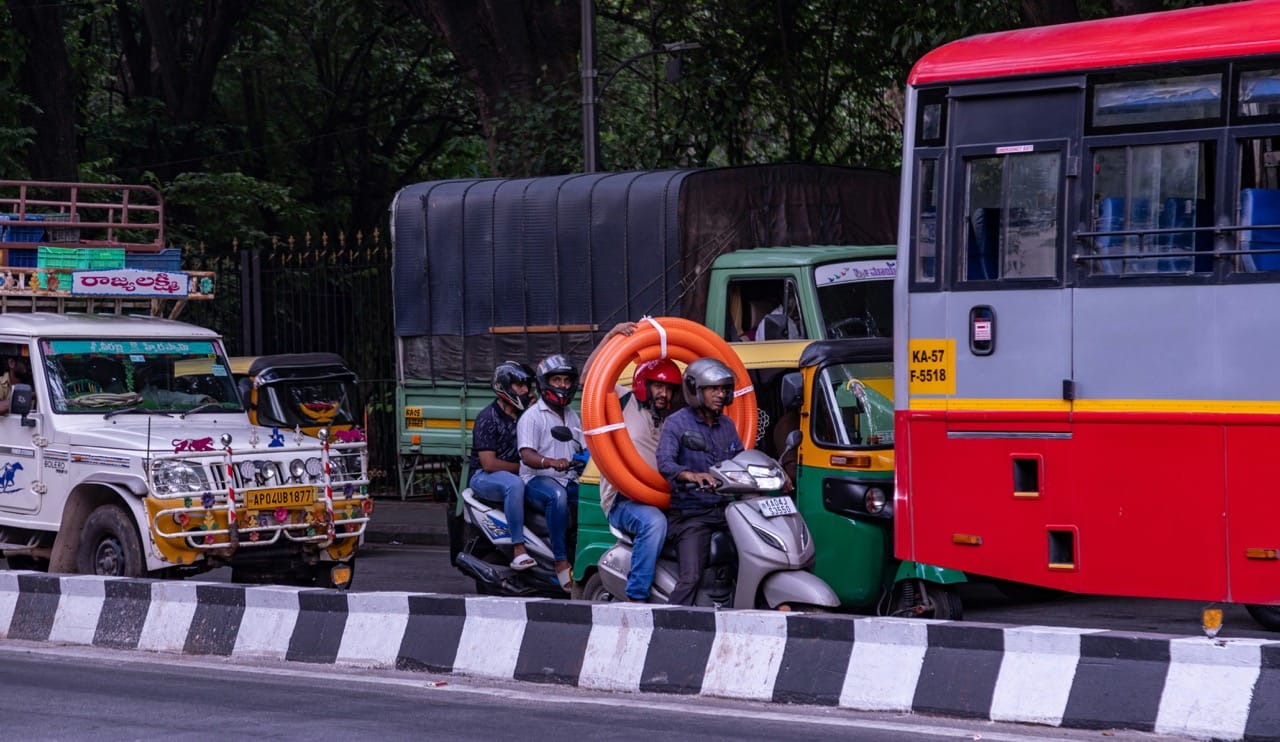
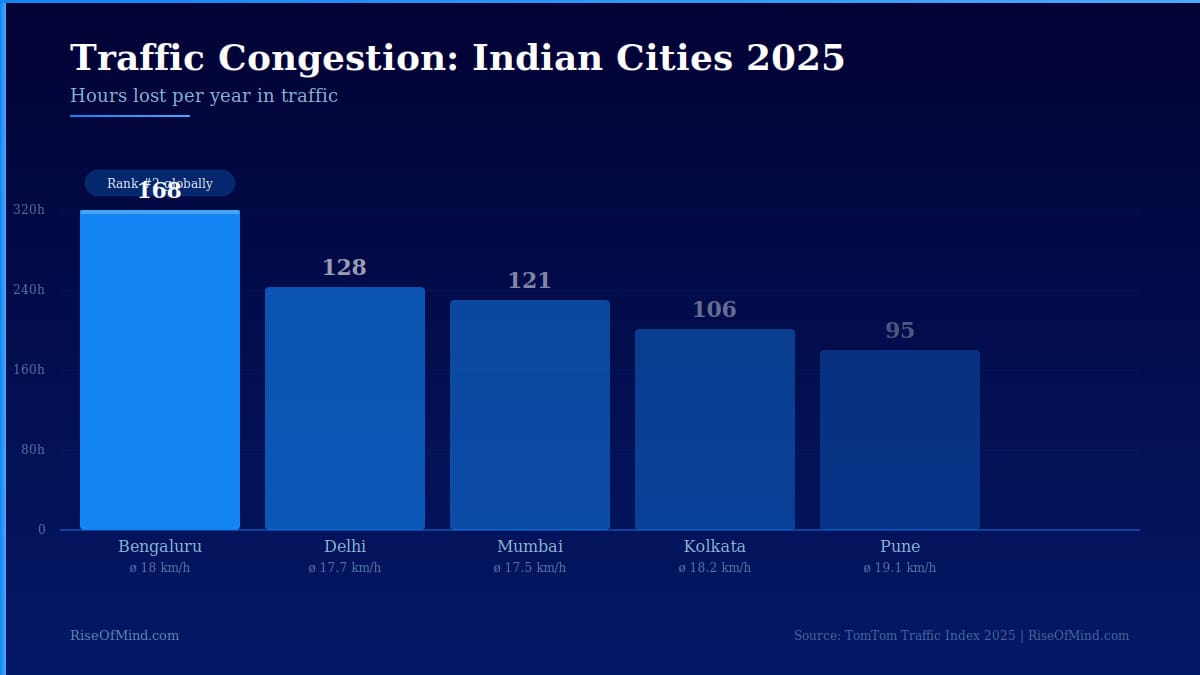
Traffic in Bengaluru is a phenomenon in itself. Two kilometres can take 30 minutes – this is not an exception, but everyday life. According to the TomTom Traffic Index, the average Bangalorean lost over 132 hours in traffic jams in 2024. In 2025, this figure rose to 168 hours – more than seven full days per year. This puts Bengaluru in second place among the most congested cities in the world.
| City | Hours Lost in Traffic per Year | Average Speed |
|---|---|---|
| Bengaluru | 168 hours | 18 km/h |
| Delhi | 128 hours | 17.7 km/h |
| Mumbai | 121 hours | 17.5 km/h |
| Kolkata | 106 hours | 18.2 km/h |
Source: TomTom Traffic Index 2025
Many roads are in poor condition, rubbish is everywhere, and road users follow their own set of rules that Europeans cannot comprehend.
Walking is not a good idea in Bengaluru – and that's more than just a question of comfort.
Pedestrians are among the most vulnerable road users in India. According to the India Status Report on Road Safety 2024 by IIT Delhi, pedestrians, cyclists and two-wheeler riders together account for by far the largest share of road traffic victims. In some Indian states, such as Bihar and West Bengal, pedestrians are even the most common group of victims in fatal road accidents. In 2024, around 180,000 people were killed in road traffic accidents in India – despite a significantly lower vehicle density per capita, India accounts for around 6% of all traffic fatalities worldwide. So if you're travelling in Bengaluru, it's a good idea to limit walking to short, straightforward routes and generally rely on local drivers for journeys.
What has changed at the same time is that over the last ten years, the vehicle fleet on Bengaluru's roads has become visibly more modern. More and more new cars are now pushing their way through the traffic jams – a silent sign of economic recovery. German vehicles are virtually unseen, with Maruti Suzuki (an Indian car manufacturer and subsidiary of the Japanese Suzuki Motor Corporation) dominating the market.
Electricity, internet and resilience
Anyone in Germany who has ever complained about a brief power cut will quickly gain a new perspective in India.
In summer, power cuts lasting several hours a day are not unusual – they are a calculated part of everyday life. Most companies, including small and medium-sized enterprises, have emergency generators that kick in without interruption. If you are sitting in a well-equipped office, you hardly notice the outage. There are entire districts where the power is cut off for industry on a daily basis. It is difficult to imagine that electric mobility will progress quickly under these conditions.
The situation is similar with the internet: companies that need to be reliably accessible usually maintain several redundant connections – different providers, different technologies. What sounds like a lot of effort is simply part of well-thought-out infrastructure planning in India. The resilience that Indian companies have developed in this regard is remarkable. They have learned to deal with uncertainties, whereas in the West we plan with certainties and are quickly helpless when minor disruptions occur.
Language: English as a matter of course
One issue that could be a hurdle for many German entrepreneurs is not a problem in India: almost everyone speaks English. This applies not only to the business world, but also to everyday situations. India has internalised English as its official and educational language to such an extent that communication in practice works more smoothly than in some European countries. This is a significant advantage that makes cooperation – at least in terms of language – much easier than many expect. The only hurdle is the dialect and the speed of speech, which even those with a good knowledge of English will find themselves having to ask for clarification from time to time.
Bengaluru: Boom, water crisis and the drive for growth
Bengaluru is the undisputed technology hub of India. This is where the big IT companies, call centres and start-ups are located. The city is home to India's $194 billion IT industry and hosts global corporations such as Google, Infosys and Wipro.
But growth has come at a price – and it is a high one.
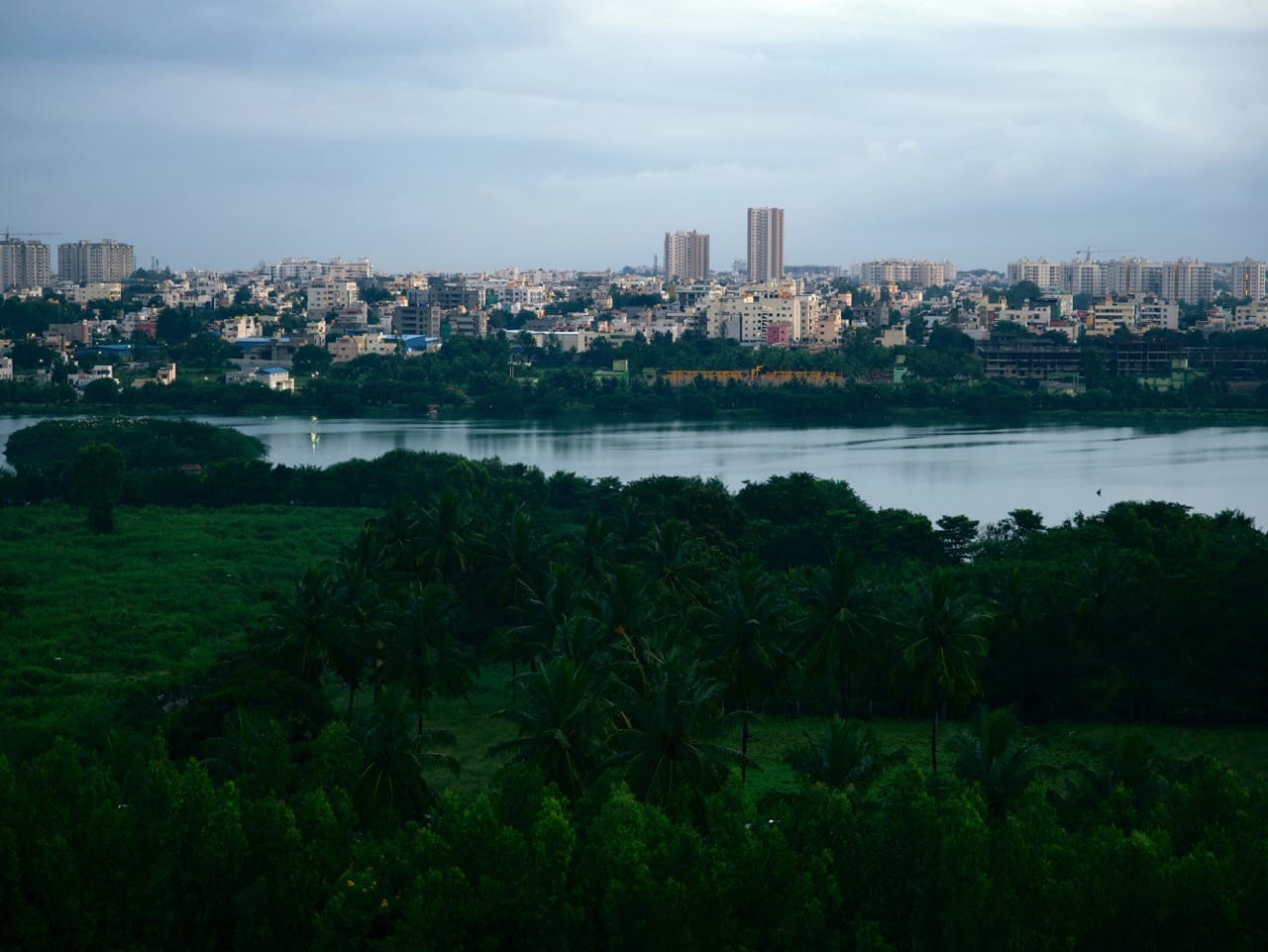
Over the past 30 years, Bengaluru has lost 74% of its lakes and rivers, which are now covered by concrete. Since the beginning of 2024, the city has been struggling with one of the most severe water supply crises in its history. Daily demand is around 2,600 million litres, but only around 2,100 million litres are available.
The main reservoir, the Cauvery River, is located around 100 kilometres away and requires considerable technical effort to pump water up almost 300 metres in altitude. Entire neighbourhoods are dependent on private water tankers.
The consequences are also being felt by businesses: more and more IT companies are relocating to other sites. Hyderabad has positioned itself as the clear winner in this regard. Between April 2023 and April 2024, IT job postings there rose by 41.5%, compared to 24% in Bengaluru. Google, for example, deliberately chose to establish its largest office outside the US in Hyderabad – not Bengaluru.
Climate and location choice: an underestimated factor
Anyone planning a location in India should take the climate seriously – not for tourist reasons, but because of its direct impact on employee recruitment, productivity and operating costs.
Bengaluru traditionally has a clear advantage here: the city is located on a plateau at an altitude of around 900 metres and enjoys a comparatively pleasant climate all year round. This is quite bearable for visitors from Central Europe – but that is by no means a given in India.
Cities such as Hyderabad and Chennai are a different matter. The heat there can be difficult for people from Central Europe to tolerate, especially in the summer months. This affects how long Western colleagues can and want to work there – and it also affects the attractiveness of the location for local professionals.
What comes next?
The second part of this series goes to the heart of the collaboration: recruiting, loyalty, moonlighting, labour law and salary expectations – and how to meaningfully integrate Indian colleagues into Western companies. It also addresses a topic that is regularly underestimated in practice: the journey of an Indian colleague to the United Kingdom – and what that really means in bureaucratic terms.
List of sources
- TomTom Traffic Index – Bengaluru https://www.tomtom.com/traffic-index/city/bengaluru (According to the TomTom Traffic Index, Bengaluru is one of the most congested cities in the world.)
- Newsreel Asia – Bengaluru, Mumbai, Delhi Among Cities with Worst Traffic Congestion Globally (Jan. 2025) https://newsreel.asia/articles/traffic-congestion-delhi-bengaluru-mumbai
- Asia Pacific Foundation – Indian Tech Hub Bengaluru Reeling from Water Crisis (May 2024) https://www.asiapacific.ca/publication/indian-tech-hub-bengaluru-reeling-water-crisis (Bengaluru's rapid growth has led to water scarcity and increasing dependence on tankers.)
- Business Today – IT Sector Sees Job Growth in Tech Hubs Bengaluru and Hyderabad (May 2024) https://www.businesstoday.in/technology/news/story/it-sector-sees-job-growth-in-tech-hubs-bengaluru-and-hyderabad-despite-national-slowdown-430775-2024-05-24
- India Status Report on Road Safety 2024 – IIT Delhi https://www.drishtiias.com/daily-updates/daily-news-analysis/india-status-report-on-road-safety-2024
- Data For India – Road Accident Deaths (January 2025) https://www.dataforindia.com/road-accident-deaths/
- Analytics India Magazine – Will Hyderabad Dethrone Bangalore’s IT Status? https://analyticsindiamag.com/it-services/will-hyderabad-dethrone-bangalores-it-status/ (The article analyses the growing competition between Hyderabad and Bengaluru as IT hubs.)
About the Author