
Creating options: The key foundation for resilience and mental strength
Change rarely feels threatening as long as life follows familiar patterns. But a single professional trigger - a market shift, organizational transformation, or technological disruption - can be enough to shake your inner stability. In these moments, it becomes obvious how heavily many people rely on just one life pillar.
The tree metaphor captures this perfectly:
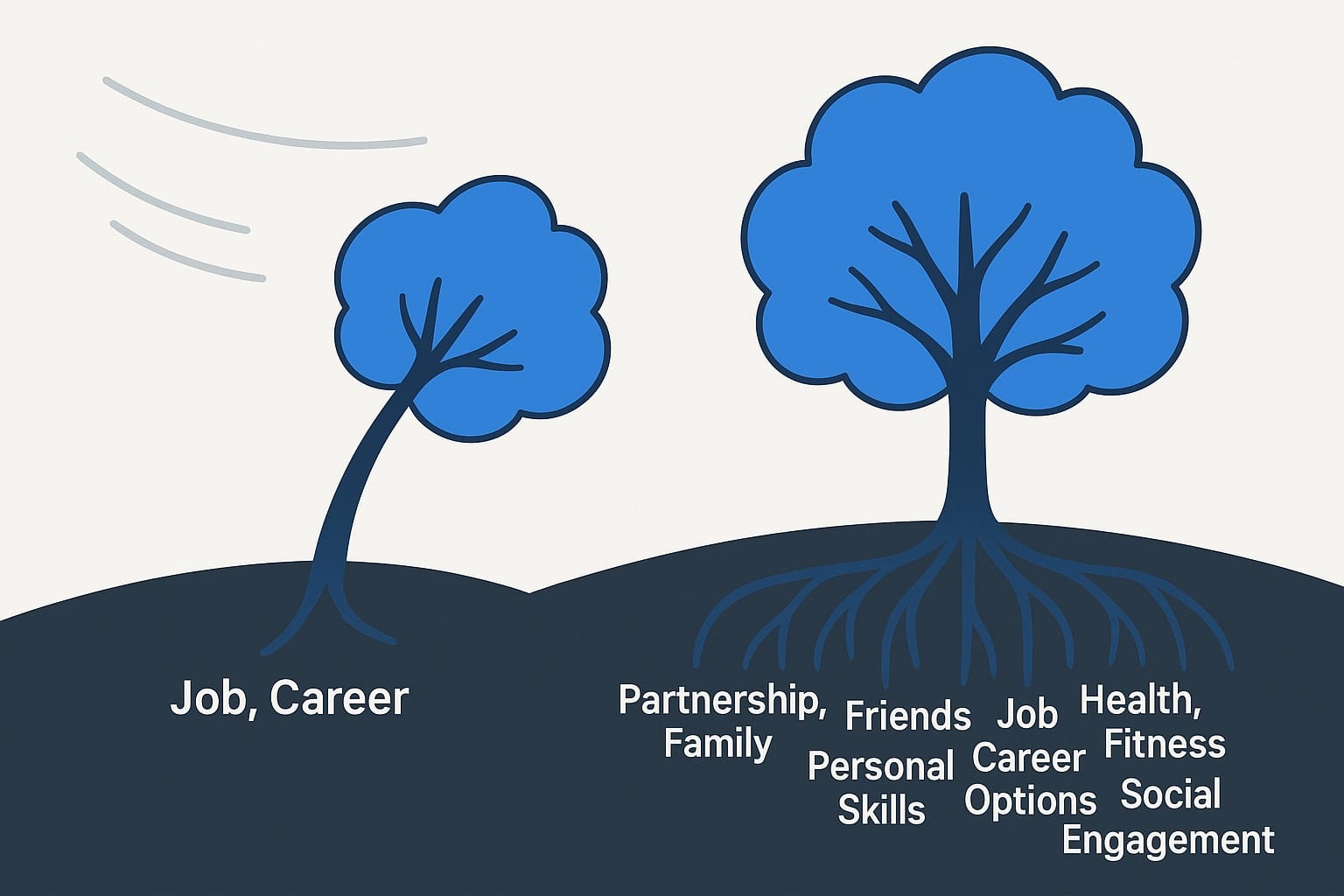
A tree with only one root will become unstable in the first storm. A tree with multiple strong roots remains firmly anchored, no matter how turbulent it gets.
This is what creating professional and personal options is about: building stability before the storm, strengthening resilience, and making future decisions easier and more confident.
Psychiatrist and Holocaust survivor Viktor Frankl expressed this mindset in one powerful sentence:
“Between stimulus and response there is a space. In that space is our power to choose our response.” - Viktor Frankl
Developing options means deliberately expanding your room for action - not reacting out of pressure when alternatives have disappeared, but proactively shaping your future before external forces take control.
Below, you will learn how to strengthen your personal agency and systematically build professional options.
1. Build your personal framework for action
Before creating new possibilities, you should clear mental and emotional space. Start with the essential question:
“What (or who) is NOT good for me?”
Letting go of mental clutter - old beliefs, draining commitments, unhelpful patterns - frees up energy. The same applies to so-called energy vampires: people who continuously drain your motivation and emotional strength. Whenever possible, distance yourself consistently.
Once space is created, you can design a framework for your next steps - your personal stage for future growth. The following creativity techniques support this process:
a) The Disney Strategy: Clarity through three perspectives
- Dreamer: Which possibilities excite and inspire you?
- Realist: What is feasible and actionable?
- Critic: Where are the risks, and what preparation is required?
This structured mindset shift enables more balanced decision-making - a key element of mental strength.
b) Life-Design Matrix: Identify high-impact options
The Life-Design Matrix is a 2×2 tool that shows how much energy a specific option requires and how strongly it influences your life.
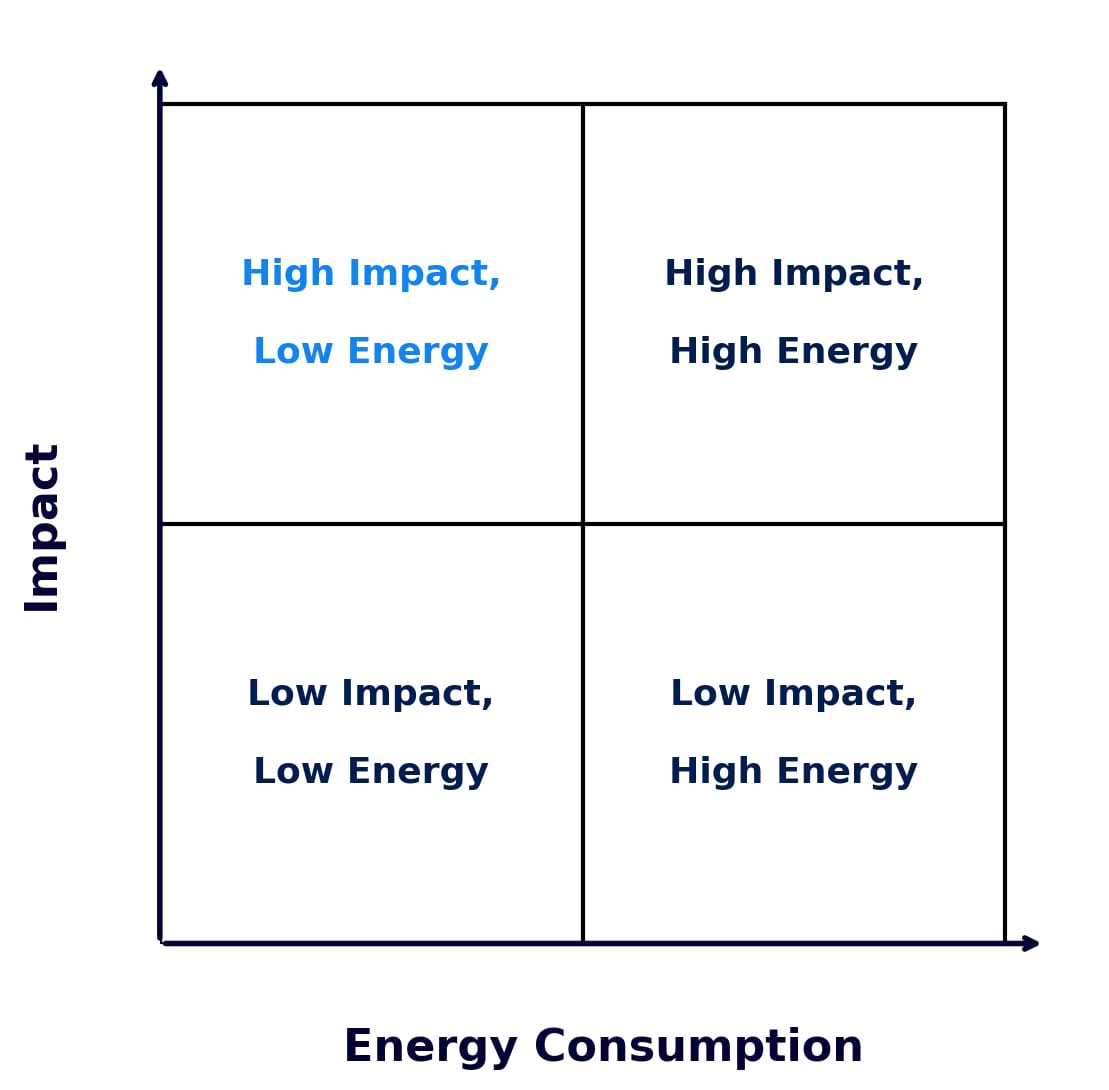
Your goal is to identify options that create maximum impact with minimal effort (energy). This High Impact, Low Energy quadrant is your sweet spot: sustainable growth without overwhelm.
c) Develop your ideal future vision
What does your ideal future look like? Visualize it vividly:
How do you feel? What do you do? What experiences shape your daily life?
Write down every detail, then ask yourself honestly:
Is this truly what I want?
Free up energy: What is NOT good for me?
- List 10 things that drain you.
- Remove or reduce them intentionally.
Expand your options:
- Apply the Disney Strategy or Life-Design Matrix to a current career question.
- Write down your future vision and refine it regularly.
2. Strengthen your confidence by updating your resume / CV
Most people underestimate their own abilities. The thought “I don’t know enough” is a common mental trap - a classic symptom of impostor syndrome.
A closer look at your resume often reveals a different reality:
You are further along, more experienced, and more capable than you believe.
“The obvious for you may be a miracle for others.” - Unknown
A current resume is not simply a job application tool - it is a reflection of your personal evolution. Updating it increases your self-confidence, strengthens your sense of self-efficacy, and supports career change and leadership growth.
Tips for a strong, modern resume / CV
General best practices
- Clear, structured layout with a polished, professional design
- Concise profile summary that highlights your identity and strengths
- Focus on measurable achievements instead of task lists
- Use clear, active language and a structured presentation for each stage
- Error-free, ATS-friendly structure (readable for Applicant Tracking Systems)
For leaders
- Clearly articulated leadership style
- Evidence of team development, organizational impact, and strategic expertise
- Demonstrated success in transformation, change, or complex stakeholder management
A truly compelling resume does not happen casually, therefore, we will cover this topic in-depth in a future RiseOfMind article.
- Update your resume / CV.
- Review and refine it at least once a year to stay aligned with your growth.
3. Cultivate a high-quality network
A network acts as an amplifier for your opportunities. Well maintained, it strengthens your personal and professional room for action. Neglected, it quickly becomes fragile.
A true network is not defined by quantity but by quality:
People who support you, recommend you, open doors, and offer honest feedback when you need it most.
Strong relationships are one of the most valuable assets in any career, especially during times of transition and mindset shifts.
30-day networking challenge
Each week:
1. Strengthen one existing connection
2. Connect with one new person
3. Re-engage one dormant relationship
Consistency creates momentum and momentum creates opportunity.
4. Build meaningful professional visibility
(Digital Presence & Personal Branding)
Visibility is not about self-promotion. At its best, it is about clarity, contribution, and relevance.
When you communicate your expertise authentically, you create qualified visibility - the kind that naturally attracts meaningful conversations, partnerships, and professional opportunities.
Focus on micro-content: short, clear, value-driven impulses rather than perfect long-form posts. In today’s digital world, consistency beats perfection. Algorithms reward regularity, and sustained visibility shapes your professional identity.
- Define your core topic or expertise
- Publish one post or meaningful comment each week
- Refine your profile with a clear message about your strengths and values
5. Consider self-employment as a strategic option
(Entrepreneurship & Future skills)
Not everyone thrives within traditional career structures. If you constantly feel the need to adapt yourself to fit a system, exploring alternative professional paths can be both liberating and strategic.
Self-employment - whether full-time or as a complementary second pillar - allows you to express your strengths authentically and build a work environment that suits your values.
The first step is creating a one-page landing page concept:
- What problem do you solve?
- What unique strengths and USPs set you apart?
- How is your idea different from existing solutions on the market?
This clarity is the foundation of a strong personal brand and a robust business model.
Financially, a simple back-of-the-napkin calculation is enough early on.
It helps answer the crucial question:
Is your idea viable with realistic effort and real market potential?
If the numbers align, your idea becomes more than a concept, it becomes a new entrepreneurial root that can grow into a sustainable business.
Tools like the Business Model Canvas (BMC) are ideal for mapping value propositions, customer segments, partners, and revenue streams.
- Create a 1-page landing page draft
- Research two competitors and define your USP
- Test viability with a simple cost-benefit estimation
Conclusion: Options are the foundation of every successful change
Creating options means building real stability, not by clinging to the familiar, but by intentionally shaping your future. You invest in additional roots that support and strengthen you when the next storm arrives.
Your room for action, your self-confidence, your network, and your visibility become a powerful system that increases resilience and keeps you capable of navigating change with clarity and strength.
Summary of tools
| Tool / Method | Purpose | Benefit for your resilience |
|---|---|---|
| Disney Strategy | Develop ideas | Clarity & creative problem-solving |
| Life-Design Matrix | Prioritization | Focus on high-impact actions |
| Future Vision (Goal Image) | Direction & clarity | Strengthens motivation & orientation |
| Resume / CV Update | Self-confidence, Self-efficacy | Recognizing your strengths & progress |
| Networking Challenge | Social capital | Stability through meaningful connections |
| Visibility on Social Media | Expand professional options | Opportunities through consistent presence |
| One-Page Business Concept | Test self-employment potential | A new entrepreneurial root to grow from |
Preview of the next article
How to navigate change successfully - Part 2
In the next article, you will learn how to let go of old patterns, expand your comfort zone step by step, and take meaningful action toward transformation.
We will introduce practical tools and proven methods to guide you reliably along this journey.
Sources
Precht, R. D. (2011): Who Am I? And If So, How Many. Goldmann Verlag.
Kuschik, K. (2025): 50 Fragen, die das Leben leichter machen. Ullstein Taschenbuch Verlag. German only.
Kuschik, K. (2022): 50 Sätze, die das Leben leichter machen. Rowohlt Verlag. German only.
Burnett, B. & Evans, D. (2016): Designing Your Life. Published by Knopf.
https://openlibrary.org/books/OL39224531M/Designing_Your_Life
Maisch, B. et al. (2024): Exploring Career and Life Design: Innovation, Resilience, and Personal Growth. Published by CERN. https://e-publishing.cern.ch/index.php/CIJ/article/view/1607/1396
Maree, K. (2017): Psychology of Career Adaptability, Employability and Resilience. Springer International Publishing.
About the Author